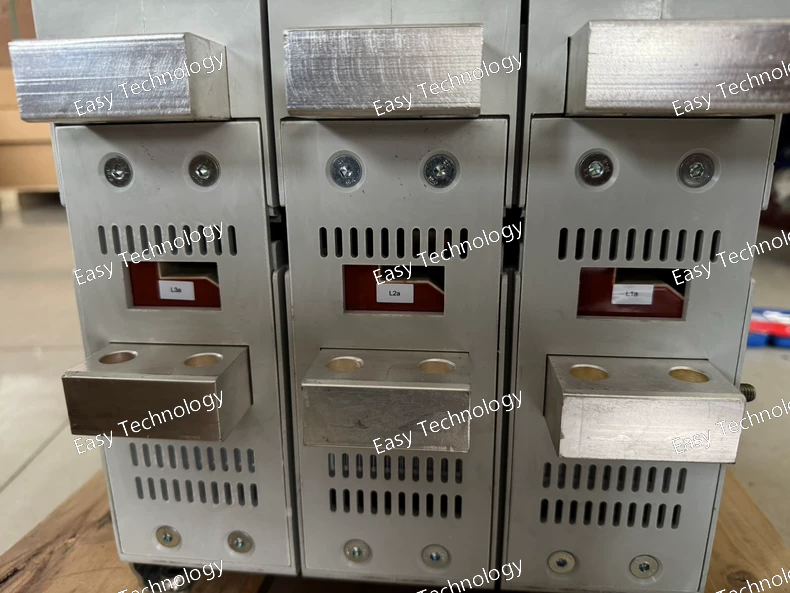
Technical Data:
Series: Emax 2 (E2)
Frame Size: S (corresponding to a specific physical frame designed for high currents, typically up to 3200A).
Rated Current (In): 2000 A (This is the nominal current rating of the breaker frame and main contacts. The actual protection settings are configured in the trip unit).
Rated Ultimate Breaking Capacity (Icu): 200 kA at 400/415V AC (The "R2000" code denotes this very high short-circuit interrupting rating).
Number of Poles: 3 Poles (3P - phases L1, L2, L3).
Trip Unit: PR123/LSIG - Advanced Electronic Trip Relay.
Protection Functions (All Digitally Adjustable):
L - Overload (Thermal Protection): Adjustable current setting (Ir) and time delay (tr).
S - Short-Time (Selective Short-Circuit): Adjustable current threshold (Isd) and definite or I²t time delay (tsd) for coordination with downstream breakers.
I - Instantaneous (Short-Circuit): Fixed or adjustable high-current trip threshold (Ii) for worst-case faults.
G - Ground Fault: Adjustable current threshold (Ig) and time delay (tg) for protection against earth leakage currents.
Communication Protocol: The PR123 unit natively supports communication protocols (typically Modbus or Profibus via plug-in modules) for remote monitoring, control, and data logging (current, voltage, power, energy, alarms).
Mounting & Operation: Draw-Out Version (FHR - Fixed Horizontal Draw-Out).
Equipped with a stored-energy spring operating mechanism. This allows for quick closing ("Charge-Close" operation) and provides the force for tripping under fault conditions.
Includes a motor charging mechanism for automatic spring re-charging.
Auxiliary Contacts: Typically includes a standard set of auxiliary contacts for signaling breaker status (ON/OFF/TRIPPED), spring charged, etc.
Standards Compliance: IEC/EN 60947-2, UL 1066, CSA C22.2 No. 5.
The ABB E2S2000R2000PR123/LSIG 3P FHR is a sophisticated Emax 2 air circuit breaker designed for main power distribution, protection, and control in large commercial buildings, industrial plants, data centers, and critical infrastructure.