Key Features
Rotary Handle Mechanism: Provides manual ON/OFF operation of the connected circuit breaker.
Adjustable Depth: Long operator shaft (~500 mm) accommodates panels or enclosures of varying thickness.
Padlock Capability: Supports padlocking in the OFF position for safety lockout/tagout procedures.
Door Interlock: Prevents door opening when the breaker is in the ON position, enhancing safety.
Designed For: Fixed‑withdrawable T7 series moulded case circuit breakers.
Mechanical & Installation
Operating Method: Rotary handle turns the breaker’s internal mechanism via a shaft connection.
Mounting Type: Front‑mounted to panel or enclosure cut‑out with adjustable depth shaft to reach the breaker.
Shaft Length: Approximately 500 mm adjustable.
Handle Style: Ergonomic rotary knob designed for clear manual control.
Compatibility: Intended for use with ABB T7 fixed‑withdrawable MCCBs.
Environmental & Safety
Padlock Device: Allows up to multiple padlocks to secure the switch in OFF condition.
Door Interlock Feature: Enhances safety by mechanically preventing door opening when the breaker is ON.
Robust Design: Suitable for industrial panel environments.
Physical & Dimensions
Adjustable Shaft Length: ~500 mm
Weight: Moderate, suitable for panel mounting.
Finish: Durable finish for industrial use.
Typical Applications
Manual operation of T7 series moulded case circuit breakers.
Safety isolation points in control and distribution panels.
Maintenance lockout/tagout procedures, using padlock facility.
Industrial control panels requiring external breaker handle actuation.
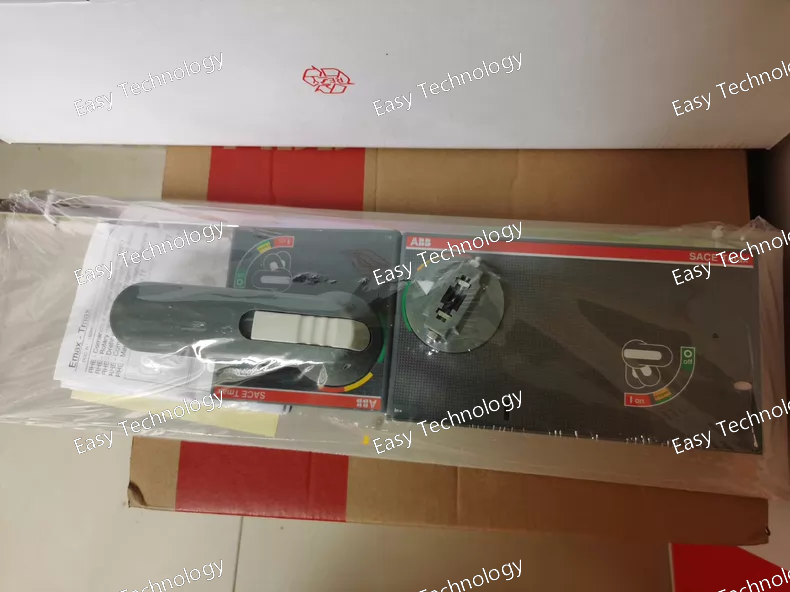
The ABB RHE NORM.Returned for F/W T7 is a rotary handle operating mechanism designed as an accessory for ABB T7 series moulded case circuit breakers (fixed‑withdrawable type). It allows manual operation of a circuit breaker from outside the enclosure and integrates safety features such as a padlock provision and door interlock. It’s adjustable in depth so it can fit panels with different thicknesses while maintaining reliable mechanical connection to the breaker’s internal mechanism.