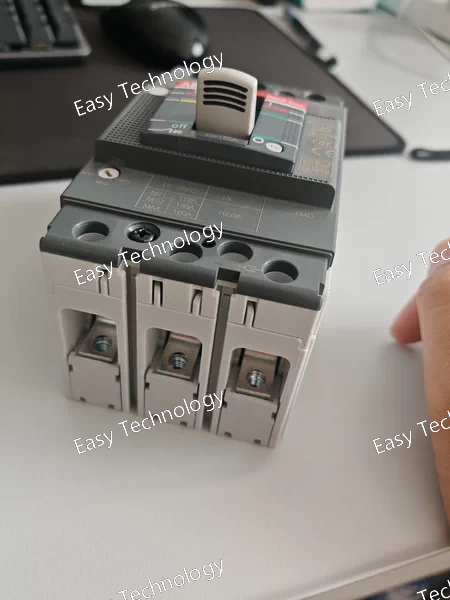
Key Technical Parameters
General & Protection
Product / Model: ABB XT1N160 TMD160‑1600 FF 3P
Device Type: Molded Case Circuit Breaker (MCCB)
Series: Tmax XT
Number of Poles: 3 (three‑pole)
Trip Unit Type: Thermal‑Magnetic (TMD)
Mounting Style: Fixed installation, front terminal connections
Current & Voltage Ratings
Rated Continuous Current (In): 160 A
Adjustable Instantaneous Short‑Circuit Setting: 160–1600 A
Rated Operational Voltage: Up to 690 V AC / 500 V DC
Rated Frequency: 50 Hz / 60 Hz
Rated Insulation Voltage (Ui): ~800 V
Rated Impulse Withstand Voltage (Uimp): ~8 kV
Short‑Circuit & Breaking Capacities
Rated Ultimate Breaking Capacity (Icu):
• ~65 kA at 220–240 V AC
• ~36 kA at 380–415 V AC
• ~30 kA at 500 V AC
• ~6 kA at 690 V AC
Rated Service Breaking Capacity (Ics): Slightly lower than Icu depending on voltage
DC Breaking Capability: Up to ~36 kA at 250–500 V DC
Performance & Durability
Electrical Durability: ~120 cycles/hour (up to ~8000 operations)
Mechanical Durability: ~240 cycles/hour (up to ~25,000 operations)
Power Loss: ~15 W per pole at rated operating conditions
Connection / Wiring: Front panel wiring with busbar or cable lug options
Environmental & Applications
Typical Operational Systems: Industrial switchboards, motor feeders, main and feeder protection in commercial or industrial electrical distribution
Standards Compliance: IEC 60947‑2
Use Cases: Overload protection, short‑circuit interruption, isolation in three‑phase AC and DC systems
The ABB XT1N160 TMD160‑1600 FF 3P is a three‑pole molded case circuit breaker (MCCB) from ABB’s Tmax XT series designed for industrial and commercial electrical protection. It combines thermal‑magnetic protection to defend electrical circuits against overloads and short‑circuits, with a fixed mounting and front‑connected terminals for installation in distribution boards, motor feeders, or panelboards. This breaker is suitable for protection of three‑phase power systems up to 690 V AC or 500 V DC and offers adjustable trip thresholds for coordinated protection schemes.