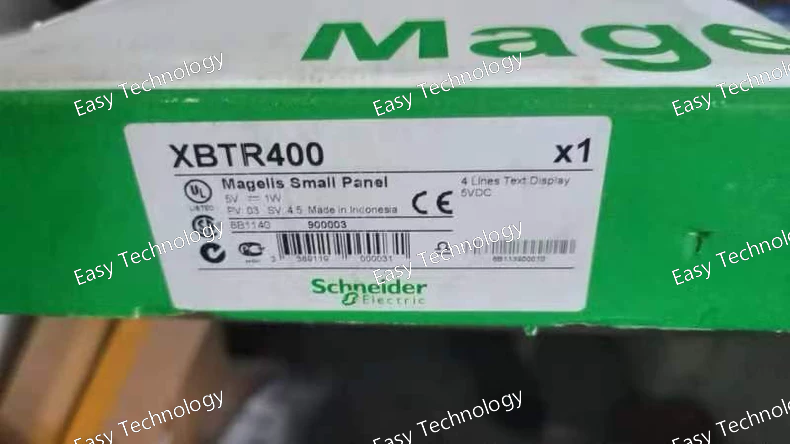
The XBTR400 is a fixed-value, PCB (Printed Circuit Board) mount current shunt resistor from Schneider Electric。 It is a highly precise and stable component used within electrical measurement and protection devices.
Specifications
Parameter Category Specification
General Information
Manufacturer / Series Schneider Electric / XBT (Internal Components)
Model / Part Number XBTR400
Product Type Precision Current Shunt Resistor (PCB Mount)
Primary Electrical Characteristics
Rated Resistance Value (Rn) Very Low, typically in the micro-ohm (µΩ) to milli-ohm (mΩ) range.
The exact value is critical and proprietary to the device it is designed for (e.g., 400µΩ, 250µΩ). It is selected to generate a standard signal (e.g., 60mV or 150mV) at the device's rated current.
Rated Current (In) High, typically several hundred to thousands of Amperes, depending on the host device's rating (e.g., for a 400A circuit breaker, the shunt would be rated for at least 400A continuous).
Tolerance Very High Precision, typically ±0.5% or better at rated conditions.
Temperature Coefficient (α) Extremely low, often < 50 ppm/°C (parts per million per degree Celsius). This ensures measurement stability across operational temperature changes.
Rated Power / Voltage Drop
Power Rating (Pmax) Designed to dissipate the heat generated (P = I²R) at the maximum continuous current of the host device without significant drift.
Voltage Drop at Rated Current (Vfs) A standardized value, commonly 60 mV or 150 mV, at the device's full-scale (rated) current.
Construction & Mechanical
Material Manganin (Copper-Manganese-Nickel alloy) or Isotan for excellent long-term stability and low thermal EMF.
Terminals Solder lugs or pins for secure PCB mounting and high-current carrying capability.
Construction May be a flat, stamped metal strip or a specialized billet with integrated terminals.
Environmental
Operating Temperature Range -25°C to +85°C or wider, suitable for the internal environment of electrical equipment.
Long-Term Stability Excellent, with minimal resistance drift over time and under load cycling.