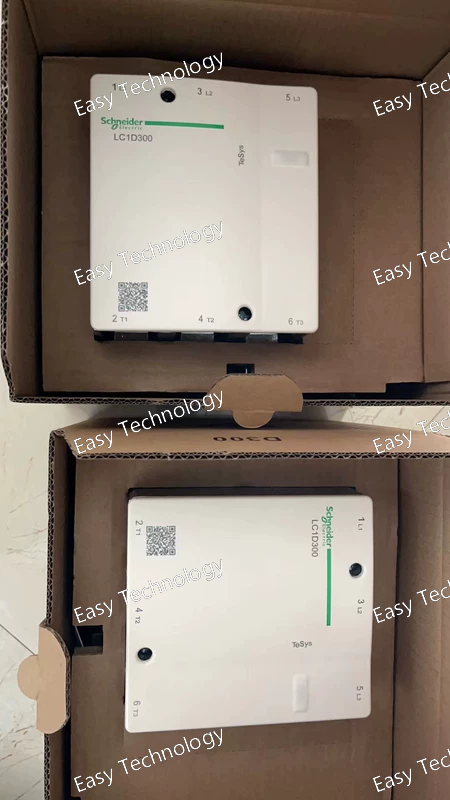
The Schneider Electric LC1D300E7C is a robust low‑voltage electromagnetic contactor from the TeSys D contactor family, engineered for reliable switching and control of AC loads in industrial and commercial applications. Designed to handle high currents up to 300 A, this contactor is suitable for motor control, power distribution, and load switching. Featuring a 220 V AC control coil, the device delivers dependable performance across resistive and inductive loads. Its compact design and standard mounting options ensure easy integration into control panels and automation systems.
Specifications
General
Product Family: TeSys D (Schneider Electric)
Device Type: Electromagnetic contactor
Model: LC1D300E7C
Number of Poles: 3 (three normally open contacts)
Application: AC motor control, load switching, power distribution
Utilisation Categories: AC‑1, AC‑3, AC‑4
Electrical Ratings
Rated Operational Current (Ie): 300 A (power circuit)
Rated Operational Voltage (Ue): Up to 690 V AC
Rated Insulation Voltage (Ui): 1000 V AC
Rated Impulse Withstand Voltage (Uimp): 6–12 kV (application dependent)
Control Coil Voltage: 220 V AC, 50/60 Hz
Conventional Free‑Air Thermal Current (Ith): 300 A
Minimum Switching Current: Suitable for control circuits (~mA level)
Motor & Load Performance
Motor Power Ratings (AC‑3 Load Duty): Capable of switching motors within 300 A capacity
Resistive Load Capability: High reliability for general resistive loads
Mechanical & Operational
Operating Mechanism: Electromagnetic coil actuation
Control Coil Power Consumption: Standard for 220 V AC
Operating Frequency: Suitable for frequent switching in industrial environments
Mechanical Life: Millions of mechanical operations
Electrical Life: High endurance when switching under rated load
Connection Type: Standard panel or DIN‑rail compatible mounting
Auxiliary Contacts & Accessories
Auxiliary Contact Blocks: Optional auxiliary contacts available (NO/NC) for control logic
Mounting: Panel mounting or DIN‑rail with accessory kits
Environmental
Ambient Operating Temperature: Industrial standard range
Pollution Degree: Suitable for industrial environments
Protection Level: Typically IP20 in installed assemblies
Vibration & Shock Resistance: Designed for industrial use